
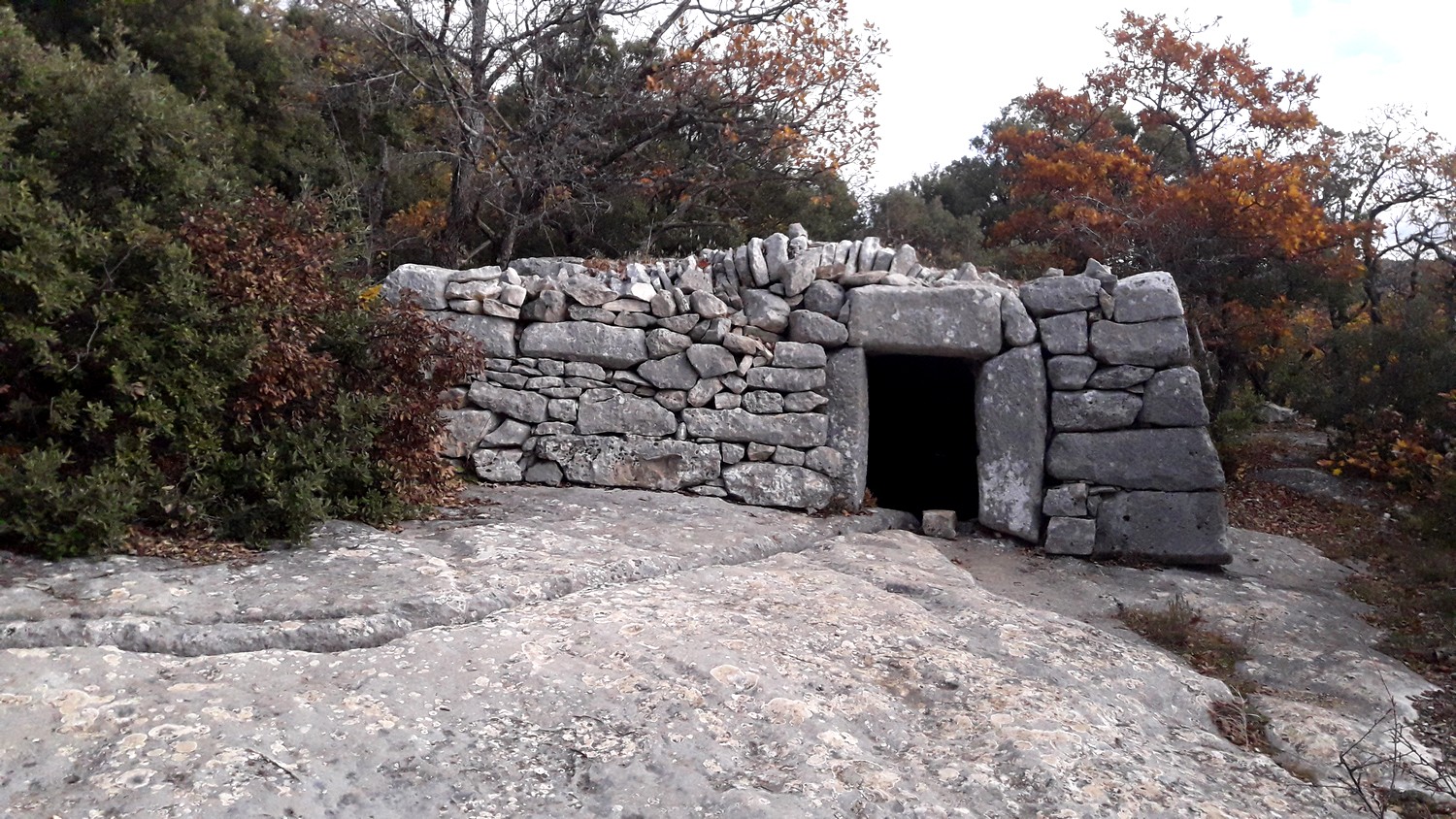
The Aiguiers (cistern from rock) of St-Saturnin-lès-Apt
« The traveler who crosses the Monts-de-Vaucluse does not suspect that arid hills looming on the horizon are also the land of endless valleys, silence, where one can walk for days without seeing another soul. To the one who penetrates its secrets, the country of aiguiers will reveal its own-value.; made of dry stone, scarce water and precious greenery...». FrançoisMorenas (1917 - 2006), innkeeper, itinerant filmmaker, writer and a trail clearer.
7 points of interest
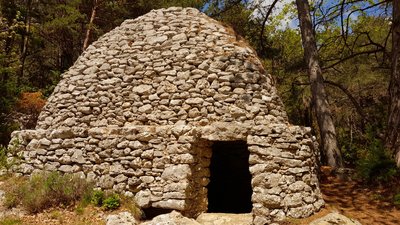
Aiguier couvert de Barralié - ©Eric Garnier - PNR Luberon  Geology
The Aiguiers
"The northeast of Saint-Saturnin-lès-Apt is named this way because many farms there only had one water supply which was a cistern dug in the limestone and fed by rainwater through a water-collecting system (impluvium)."
From the book "Saint-Saturnin au fil du temps"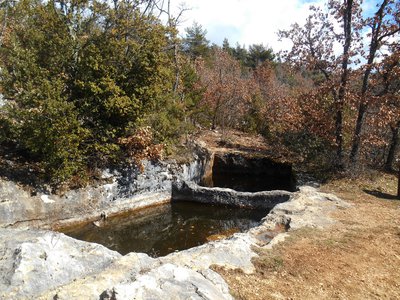
Aiguier ''jumeaux'' de Bessons - Marie Grenouilleau - PNR Luberon  Elevage et pastoralisme
The Aiguiers (underground tanks)
On the hills of Saint-Saturnin-lès-Apt, men have built and maintained many aiguiers (Provençal term for"aigo" meaning water). These basins dug into the limestone and fed by rainwater by an ingenious system of recovery of run-off water, have long allowed the maintenance of rural housing and the watering of cattles on arid land.
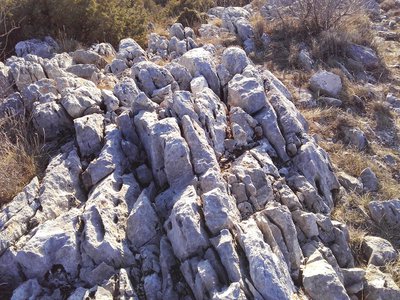
Lapiaz du Cluyer - Eric Garnier - PNR Luberon GeologyGroove, channel, I am ...
the lapiaz (limestone pavements).! On cliffs, you can see grooves, ridges saturating the rock. These are "lapiés" or "lapiaz" in the singular form. The rainwater has eroded the rock by a process of dissolution to dig the channel in the limestone. The water which continues to rush into these grooves feeds the underground springs.
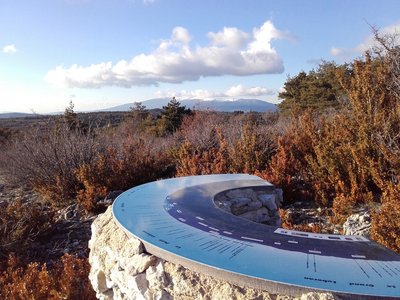
Mont-Ventoux depuis le Cluyer - ©Eric Garnier - PNR Luberon  Panorama
The treasure hunt of underground tanks
Between Ventoux and Luberon, this wooded limestone massif is the witness of an ancient human presence. A real treasure hunt will guide you through the mountains to discover a rich heritage of stone, associated with the collection and storage of water. In contrast, the open view of the Calavon valley shows a more contemporary human activity: recent urbanisation of villages, agricultural activities in the plain ...
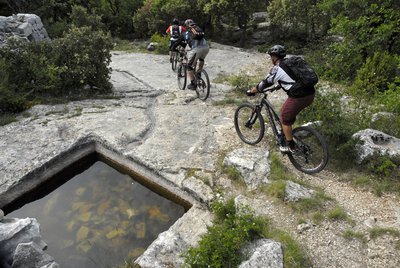
Aiguiers de Travignon - ©William Fautré  Patrimony and history
The country of Apt, Saint-Sat', land of mountain biking
The country of Apt, at the heart of the Luberon, has always been a renowned spot for mountain biking. Many bikers have tested their bike ranges on the rugged trails. In winter, the southern slopes of the Monts-de-Vaucluse, above Saint-Saturnin-lès-Apt, proves to be one of the best places to ride in the dry area, mud-free and protected from the mistral. The Grande Traversée VTT of Vaucluse passes through here, starting from the northern side of Ventoux and towards the Luberon until Mérindol (400km).
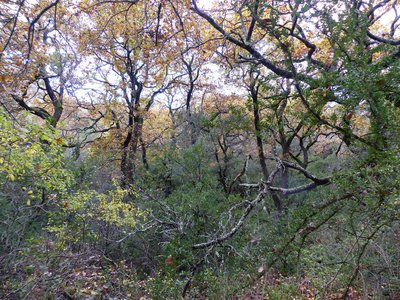
Chênaie blanche à l'automne - ©Laurent Michel - PNR Luberon  Flora
FloraThe White Oak
White Oak, also known as Downy Oak is a deciduous species, unlike the Holm Oak. It enjoys the cool conditions of the valleys and higher altitudes. It is accompanied by the Shadbush, the Estrusque Honeysuckle, the Whitebeam ... In the Combe de Travignon, the forest is old, and has been exploited for centuries to provide fuel and charcoal.
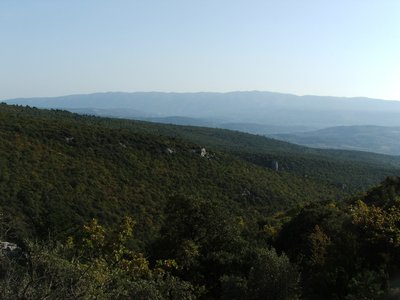
Chênaie verte du vallon de Travignon - ©Eric Garnier - PNR Luberon FloraThe Holm Oak
On the southern slopes of the Monts de Vaucluse, the Holm Oak (Evergreen Oak) occupies the lower altitudes, from 200 to 700m.. This forest is in the form of brush, remnants of an intensive operation system which provided firewood or charcoal directly, manufactured on site in charcoal burners. The Holm Oak is accompanied by distinctive shrubs: Mock Privet, Buckthorn, Montpellier Maple ...
Description
Back facing the car park, go down across on the paved track. After the turn; go back up gently. At the 1st intersection, turn left and climbthe track. Leave behind several roads to the right then to the left leading to houses. Pass a sloping ledge and reach the Aiguiers Bessons.
1- Rise to the right onto the path. At the 1st crossing, continue the winding paths across (new variant). At the path, still continue across. A little further, leave a track going to the right and continue on the rocky ledge. Reach a viewpoint and climb the edge to the east (marking hardly noticeable). Reach a small covered aiguier. Continue to the right, pass the orientation table and reach the Cluyer dome (mountain pass cycling milestone).
2- From there, head right; 50 meters further on, turn right into the passage between the boxwood and serviceberry bushes (be sure to follow the green dots on the ground). Emerge onto the south face and descend 30 meters to a remarkable viewpoint. Then, retrace your steps to point 3. At the wooden marker post, go straight ahead and then turn right (green dots no. 5). Follow the path heading due north (green dot), continue under the pine trees, and emerge onto the La Liguière track. Turn left and follow the forest service track (DFCI) for about 250 meters to find the Barralier *aiguier* (stone water cistern), hidden in the undergrowth uphill from the track. Retrace your steps to point 5, then—this time at the junction—continue straight ahead for 150 meters (green dots no. 5 and no. 14). At the Y-junction, take the La Cassette path to the left, marked "Sentier des Aiguiers" (green dot marker no. 14). Be sure to stay on the marked path (green dot)—please respect the area, as this is a private path! Go around the house to the right (past the barrier), then take the track to the left, descend, and emerge onto another track. Follow this track to the right to reach the Gayéoux *aiguiers* (green dot marker no. 14).
3- At the junction with the Travignon track, turn right and descend the track (following GR® markers and green dot #14). After 300 m, continue straight along the track; then, 100 m further on (at a wooden marker post), leave the track and the GR® route to head up the path to the left (marked with a green dot #14). Climb through the woods to reach the Collet de Travignon, then descend the southern slope. You will emerge at the Travignon *aiguiers* (traditional stone cisterns). Next, make your way along the rocky trail that cuts across two bends of the nearby wide track, reaching the first ruins of the hamlet of Travignon (marked with a green dot #14). Facing the wooden marker post, turn left and pass through the Travignon ruins (private property; risk of collapse—do not enter!).
4- At the "Travignon" junction, turn right and immediately descend the old mule track to the left (GR® markers and green dot no. 14). Navigate four switchbacks; then, near two large rocks, leave the GR® trail to the left and descend the path to the right (green dot no. 14 marker). Climb slightly to reach the Romanet track. Follow it downhill to the left for 1 km (yellow PR markers and green dot no. 14).
5- Leave the track (at the 754 m point) and head up the path to the right (green dot no. 14 marker). 200 m further up (at a marker post), turn left and climb the trail. Continue along a level section, then a slight descent, before gradually climbing up to a track serving the Caulet farm (green dot no. 14 marker). Follow the track down to the left, climb slightly, then turn left (at a marker post). Descend the trail heading south (green dot no. 14 marker).
6- After rounding a bend (marked by a boundary stone), continue straight down for another 50 m, then weave left between the oak trees to reach the secluded "Grognards" *aiguiers* (stone cisterns) (green dot marker no. 14). Retrace your steps to the boundary stone, then turn left (green dot marker no. 14). You will emerge at the corner of a fence. Turn left, follow the fence line, and come out onto the Romanes track. Head down to the left; 200 m further on, continue along the track to the right and return to the starting point by retracing the route taken on the way out.
Discovery Route no. 14 from the Saturninoise Hiking Association (ARPS).
- Departure : Leave the Longuets along the D230, 6 km north of Saint-Saturnin-lès-Apt
- Arrival : Leave the Longuets north of Saint-Saturnin-lès-Apt
- Towns crossed : Saint-Saturnin-lès-Apt
Forecast
Altimetric profile
Recommandations
- Between points 1 and 4: ATTENTION PASTORAL ZONE, in the presence of protection dogs coming to meet me, I do not caress them or threaten them. I stop, then I patiently wait for the “control” to end before calmly continuing on my way, bypassing the herd as much as possible. Preferably do not bring your dog and, if not, keep it on a leash
- Before point 2: Be careful of your ankles when crossing the rocky areas (lapiaz) as you approach the Cluyer dome
- At point 4: do not enter the ruins of Travignon; private, risk of collapse!
- Respect the tranquility of the place, the ancestral heritage and the properties (some ewers and bories are private).
- Refrain from collecting mushrooms and do not enter truffle-producing areas.
- Even if the hiker always has priority, remain vigilant when approaching mountain bikers, who are very present on the local trails.
- FIRE RISK: fire is the enemy of the forest… and of the hiker! I don't smoke in the forest or light fires, especially since whatever the season, it's forbidden! And in the summer, before going for a walk, I find out about the conditions and regulations for access to forest areas.
Information desks

Luberon UNESCO Global Geopark
60, place Jean Jaurès, 84400 Apt
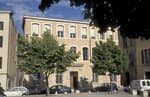
House of the Luberon Regional Nature Park
60, place Jean Jaurès, 84400 Apt
In the heart the old town centre of Apt, the House of the Luberon Regional Nature Park welcomes you in a town house of the 18th century. The permanent exhibition of the geology museum has a rich collection of fossils evidencing the geological history of the Luberon.
On sale at the shop: books, maps, guidebooks, games, posters...
Open Monday to Friday from 8:30 am to 12:00 pm and from 1:30 pm to 6 pm (and on Saturday, depending on the program). Free admission.

OTI Pays d’Apt Luberon
788 avenue Victor Hugo, 84400 Apt
Du 1er avril au 30 septembre
Ouvert du lundi au samedi de 9h30 à 12h30 et de 14h à 18h.
Juillet et août : Ouvert dimanche et jours fériés de 9h30 à 12h30
Du 1er octobre au 31 mars
Ouvert du lundi au mardi et du jeudi au samedi de 9h30 à 12h30 et de 14h à 18h.
Fermé le mercredi, dimanche et jours fériés.
Access and parking
At 9km from Apt, the D900 and D943, and the D232 after 5km above Saint-Saturnin-lès-Apt.
Parking :
More information


Source

Report a problem or an error
If you have found an error on this page or if you have noticed any problems during your hike, please report them to us here: